

Reviewed · MILAN SELF-GUIDED AUDIO TOURS
e-Scavenger hunt Milan: Explore the city at your own pace
Milan’s best-known sights are spread across a walkable central area, and this app-led scavenger hunt gives you a reason to connect them. You solve questions, complete small research tasks, and move from Piazza Fontana through the Duomo area, Brera, Sforza Castle, and other historic corners.
I like the freedom to start and stop at your own pace, and the private format works well for a family or group of friends. The main caution is that this is a game, not a traditional guided tour. One unhappy customer found the instructions unclear and expected more guide-style explanation, so bring patience and a working phone with data.
Key points to know before you book

- The route begins at Piazza Fontana, a central location close to Milan’s cathedral district.
- You visit major sights and lesser-known details, from the Duomo roof statues to San Fedele’s painted false apse.
- The private price covers up to six people, making the $36.07 group cost more appealing for families and friends.
- Plan on two to four hours, depending on your walking speed, research time, and how long you pause at each sight.
- Your smartphone and data are not included, so download the app and check your connection before setting out.
- This is a self-guided game, with no in-person guide named or supplied for the route.
What this Milan scavenger hunt actually feels like

Think of this experience as a city walk with a quiz attached, not as a guided sightseeing tour. The app gives your group prompts and tasks, then points you toward Milan landmarks. You answer questions and do research as you go.
That format can make a familiar city walk more engaging. Instead of simply snapping a photo of the Duomo and moving on, you have a reason to look closely at its statues, search for details, and talk with the people in your group.
The tradeoff is clear. A human guide can explain why a church matters, adjust the pace, answer follow-up questions, and rescue a confused group. This app cannot do that in the same personal way. The supplied customer feedback includes a low rating from someone who expected a guide and found the game only partly functional, with poor explanations. Take that warning seriously if you want a polished history tour.
For families, teenagers, and independent adults who enjoy solving clues, the format may be a good fit. You are not tied to a group leader, a fixed departure time, or the pace of strangers. You can pause for coffee, food, photos, or a closer look at a church.
More self-guided audio tours in Milan:
- Milan: City Sightseeing Hop-On Hop-Off Bus with Audio Guide
★ 4.0 · 6,256 reviews - Milan: Sforza Castle Entry Ticket with Digital Audio Guide
★ 4.0 · 2,675 reviews - Milan: Museum of the 900 Entry Ticket with Audio Guide
★ 4.4 · 72 reviews
Starting at Piazza Fontana
The stated meeting point is Piazza Fontana, at 20122 Milano MI. This places you in the historic center, close to the cathedral district and several important Milan sights.
The activity ends back at the meeting point, so you should plan your route with that return in mind. The expected duration is about two to four hours. The range is fairly wide because the app leaves the pace to you. A fast group that focuses on the clues may finish closer to two hours. A family stopping often, researching answers, and looking inside available churches could take longer.
The walk includes many locations, but the information does not give a precise street-by-street sequence. Use the app as your route guide rather than assuming every stop follows the order presented in the tour description.
The Duomo, Galleria, and Piazza Mercanti
The central part of the route brings you to Milan’s big visual stars. The Milan Cathedral is the city’s Gothic centerpiece, officially the Metropolitan Cathedral-Basilica of the Nativity of Saint Mary. Even if you have seen photographs, the scale and detail of the building reward close attention.
The route specifically points to the cathedral roof, where statues join the better-known gargoyles. That is a useful prompt because many people look up only briefly. If the game asks you to inspect the building, take time to notice how much work is packed into the upper levels.
Nearby, the Galleria Vittorio Emanuele II gives you a different side of Milan. It is Italy’s oldest active shopping gallery and one of the city’s major landmarks. Its glass-and-iron structure links the cathedral area with La Scala, and its shops make it an easy place to pause.
The Galleria is not just a shopping stop. The architecture is the real reason to look around. The game format may encourage you to notice details you would otherwise pass while heading straight to the Duomo.
Duomo Square is enclosed by the cathedral and draws large crowds for shopping as well as sightseeing. Expect this part of the walk to feel more crowded than the quieter church stops. The app may help you focus, but it cannot remove the noise or foot traffic.
Casa Panigarola, also called Palazzo dei Notai, takes you toward Piazza Mercanti, the former medieval center of Milan. This historic building offers a change from the grand cathedral setting. It is the kind of stop that benefits from a scavenger hunt because you may otherwise walk past it without knowing what you are seeing.
Churches with details worth hunting for
Several stops are churches or former religious buildings. Their value lies less in a single famous view and more in the details the game asks you to find.
San Fedele is a Jesuit church dedicated to Saint Fidelis of Como, the patron of the Catholic diocese of Como. The church gives the route a quieter, more focused stop after the open spaces around the Duomo.
Another church is known for its false apse, an early example of trompe-l’œil associated with Donato Bramante. A painted architectural illusion can be easy to miss if you simply step inside and glance toward the altar. Here, a question or research task gives you a reason to inspect the space carefully.
The route also includes the former Basilica di Santa Tecla, a Paleo-Christian basilica in Milan. This stop points to the city’s earlier religious past, before the later Gothic and Baroque buildings took over the center.
The Basilica of San Lorenzo Maggiore is another major church on the walk. It is located within Milan’s former ring of canals and was originally built in Roman times. That Roman connection adds a useful layer to the game. Milan is often sold through fashion, design, and the Duomo, but this stop reminds you that the city reaches much further back.
One listed fountain has a rectangular base designed by Giuseppe Bovara. Water flows through three mouths, two on the sides and one at the front. That is a small detail, but it shows how the activity works at its best. The app can turn a passing fountain into a specific observation task.
A few more Milan tours and experiences worth a look
- Transfer Milan City Centre – Bergamo Airport
★ 4.5 · 975 reviews - Milan: The Milan Pass City Card
★ 4.0 · 655 reviews - From Milan: Day Trip to Venice with Guided City Tour
★ 4.4 · 614 reviews - Milan: Guided Duomo, Last Supper and City Centre Tour
★ 4.5 · 452 reviews
Brera and Milan’s art district

The route includes Brera, part of Milan’s Centro Storico. This elegant district is home to the Pinacoteca di Brera, the city’s main public gallery for paintings and one of Italy’s leading collections of Italian art.
The scavenger hunt does not appear to include museum admission. Treat the Pinacoteca as an exterior landmark unless the app gives you separate instructions and you choose to enter on your own. That distinction matters because a timed museum visit would change the length and cost of your outing.
Brera is a useful section of the walk for people who want more than headline monuments. Its streets and buildings give you a different feel from the cathedral square, while the gallery adds a strong art connection. If your group includes children, the questions may help keep attention on the area. If everyone wants a full museum visit, allow extra time and budget separately.
The app’s research assignments may also be more appealing here than a simple fact sheet. You are asked to find information rather than receive every detail passively. That can make the experience more social, but it also means you need to be comfortable looking things up on your phone.
Sforza Castle and Porta Sempione

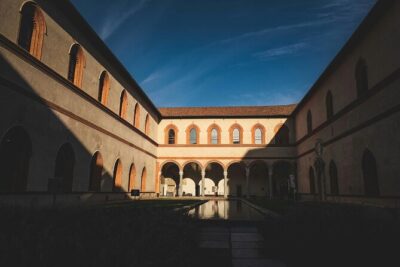
Castello Sforzesco is a medieval fortification built in the 15th century. It gives the route a large architectural change after the churches, galleries, and shopping arcades of central Milan.
A castle is a natural setting for a game. Walls, towers, courtyards, and historic figures give the app plenty of material for questions. The supplied information does not promise museum entry, so do not assume the price includes access to the castle’s collections.
The route also includes Porta Sempione, a city gate. The name applies both to the gate and the surrounding district. This is a good example of a stop where the app can clarify local geography. You are not just seeing a monument, you are learning how the gate relates to the wider area.
Because the activity returns to Piazza Fontana, the castle and gate may add a fair amount of walking. The exact route length is not supplied, so wear comfortable shoes and keep the two-to-four-hour window flexible. The app is designed to show you more than a casual walk might, but extra sights also mean extra steps.
Santa Maria delle Grazie and The Last Supper
Santa Maria delle Grazie is a church and Dominican convent, and it is also a UNESCO World Heritage Site. The convent’s refectory houses Leonardo da Vinci’s The Last Supper, a late 15th-century mural.
This is one of the most important stops on the route, but it comes with a practical limit. The activity information does not include admission to see the mural, nor does it say that a reservation is arranged. You should not treat the scavenger hunt as a ticket to The Last Supper.
The exterior and the surrounding complex can still give the game a strong historical focus. If seeing Leonardo’s mural is a main reason for your Milan visit, arrange that separately and do not rely on this app to provide entry.
The same point applies to any indoor sight along the route. This product includes an online game and city walk, not listed museum or attraction tickets. The price is for the app experience.
Palazzo Litta and the route’s architectural range

Palazzo Litta, also known as Palazzo Arese-Litta, is a Baroque structure in Milan. Its inclusion widens the route beyond medieval fortifications and Gothic churches.
For you, the benefit is variety. In one outing, the app directs attention to shopping architecture, a cathedral, religious buildings, Roman-era foundations, a castle, an art district, and a Baroque palace. That range helps explain Milan as more than a fashion capital.
The route also includes several short clues tied to individual objects or architectural features. These may not all feel equally important, but they keep the walk active. You are less likely to drift through the center on autopilot.
Price, group size, and practical value
The supplied price is $36.07 per group of up to six people. That is not a per-person charge, so the value improves sharply when four to six people share it. A family of six pays far less per person than a solo visitor.
For two people, the cost is still reasonable if you enjoy app games and would otherwise buy a separate self-guided tour. For one person, the value is more personal. You are paying for flexibility and a structured route rather than for live explanation.
The price does not include your smartphone or data. Check that your phone is charged, that you have mobile data available, and that you can download or open the app before you reach Piazza Fontana. A dead battery would turn a clever city game into a very ordinary walk.
The activity is available daily from midnight to 11:59 p.m. in the stated operating period, from December 1, 2021 through June 16, 2026. Those broad hours give you plenty of freedom, but they do not mean every church, museum, or attraction on the route will be open at every time. The app may run at any hour, while indoor sights follow their own schedules.
Confirmation is received at booking. Service animals are allowed, public transportation is nearby, and the activity is described as suitable for most participants. It is also designed to be user-friendly for people with hearing impairments. Your group is private, so only your own party takes part.
Free cancellation is available if you cancel at least 24 hours before the start time. Inside that window, the payment is not refunded, and late changes are not accepted.
Who should choose this format
I would choose this experience for a small group that wants structure without a guide. It suits families, friends, and independent visitors who enjoy questions, phone-based tasks, and the freedom to linger.
It is also useful if your group has different interests. One person can focus on architecture, another can search for answers, and everyone can pause when a church, shop, or café catches their eye.
I would be more cautious if your main goal is detailed art history or a smooth explanation of Milan’s past. The app provides a game and research assignments, not the conversation you get from a live guide. The one detailed negative experience describes unclear instructions and disappointment with the amount of explanation, so set the right expectation before booking.
Should you book the Milan e-Scavenger Hunt?
Book it if you want a flexible private walk that connects Milan’s biggest sights with smaller architectural details. The up-to-six group price is the strongest reason to consider it, especially for a family or group of friends.
Skip it if you want guaranteed entry to The Last Supper, a museum-led experience, or a guide who explains every stop in person. For the best result, bring a charged phone, reliable data, comfortable shoes, and a willingness to solve clues rather than simply follow a narrated tour.
FAQ
Where does the e-scavenger hunt start?
It starts at Piazza Fontana, 20122 Milano MI, Italy.
Where does the activity end?
The activity ends back at the meeting point.
How long does the Milan scavenger hunt take?
The expected duration is approximately two to four hours.
How much does the experience cost?
The stated price is $36.07 per group of up to six people.
Is a smartphone included?
No. You must provide your own smartphone and data connection.
Does a live guide lead the group?
No live guide is specified. The experience uses an online app to provide the game, questions, and research tasks.
Can I cancel for a full refund?
Yes. You can cancel at least 24 hours before the start time for a full refund. Cancellations or changes made within 24 hours are not refunded or accepted.
Just added around Milan
- Visit of Verona and Lake Garda. Full day tour from Milan★ 4.6 · 5 reviews
- From Milan: Villa del Balbianello and Varenna by Train★ 4.2 · 27 reviews
- Explore History and Style with this Walking Tour in Milano★ 5.0 · 15 reviews
- Trekking in the Wood with picnic on the turtles lake★ 5.0 · 9 reviews
- LINATE – MILANO airport transfer★ 4.5 · 14 reviews
- Hot air balloon flight Milan Monday-Friday★ 5.0 · 18 reviews
- Trekking in the Wood with picnic on the turtles lake★ 5.0 · 8 reviews
- Lake Como trekking private guided tour, from Milan★ 5.0 · 9 reviews
Milan Self-Guided Audio Tours, compared.
Sforza Castle Entry Ticket with Digital Audio Guide
Read our review →

Natural History Museum Entry Ticket & Audio Guide
Read our review →
Museum of the 900 Fast-Track Entry Ticket & Audio Guide
Read our review →
The Magic of Navigli: Self-Guided Puzzle Quest in Milan
Read our review →Browse the lists this tour appears in